Sunday, January 22, 2012

Student Debt vs. Freedom


On the first day of class I talked about the contrast between today's students, who are so over-burdened with debt and work that they have no framework or time to think of freedom, and the student protesters at Berkeley in 1964, whose main concern was not money (since college was so inexpensive and well supported by the State back then) but freedom and civil rights.  It is very easy for students today to envy the students at Berkeley in the 60s, or to deride them as hippies of a bygone era who had nothing better to do than to protest.  But it is a stark lesson in contrasts that should wake us up to the ways that growing student debt is not just a problem for the individuals affected but also a very serious problem for our democracy.  

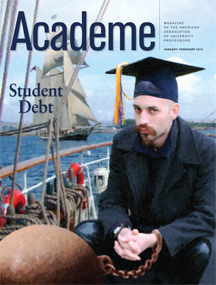
The evening after our first class I went home to find the latest issue of the AAUP's Academe with an article by Jeffrey Williams titled "Academic Freedom and Indentured Students," which makes an extended comparison between indebted students today and the indentured servants who helped settle this country. It brings home the opposition of debt and freedom in ways I hadn't anticipated.  Anyone interested in the question of debt should read this article, and anyone interested in pursuing this topic should definitely track down other articles by Professor Williams, who has written extensively on the subject.  


After reading that article, pause to listen to Mario Savio's speech on the Sproul Hall steps in 1964.  And ask yourself whether or not students today will rise up to reclaim their freedom in the same way -- or if they just have too much to lose today by doing so.

Friday, January 20, 2012

The Expos Five on "Wake Up Rutgers"


The Expos Five from Expos the Movie on Vimeo.

On Monday, I will appear on "Wake Up Rutgers" on RUtv from 9:00-9:30 am to discuss my film The Expos Five, which is a "required reading" for our class this term.  If you are up that early in the day, you might check it out, if only to tell me how it went.  The Expos Five has been getting some attention of late, and I just noticed that they are re-running an item from last semester on the main Rutgers website titled "Course Taken, Lessons Learned."  RUtv also ran a program last term which you can view on YouTube.


I am glad to promote the film because I made it to reach students, and reaching them requires publicity.  The film has only had 3,200 views, which means I am certainly not reaching all of the 6,000 or so students who take the class each year.  The whole idea of the film is to connect with students "where they live" and show them how the choices they make can have a big impact on their success in the course.  I often tell people that the film is sort of like "Goofus and Gallant Take Freshman Writing," because it shows how attitude and action are everything.  If you want an "A," act like an "A-student," not like the students who struggled.


At the same time that the film has a moral lesson, I think it also serves as an interesting window on the life of freshmen at Rutgers, and in that way is a good companion to our readings by Michael Moffatt and Rebekah Nathan.  I look forward to the discussion.

Thursday, January 5, 2012

Back to "College!"

Back to "College!" after a two-year hiatus!  Actually, it has been two years teaching other courses for the Rutgers Writing Program and working on other projects.  I haven't exactly been on sabbatical.  But I am glad to be back to teaching a course about issues affecting higher education, which are the issues that matter to me most and the issues which I find every college student can connect with in some way.  After all, we are all at college (exclam!)   


I am especially looking forward to teaching the course as a "hybrid," meeting only one day each week supplemented by online work.  It will give me a lot of opportunities to try out different technologies, especially Google Docs, Blogger, and Prezi, which will make this a very productive and successful class.  In my Spring 2010 class, students had good experiences with their blogs, and I was pleased to discover that all of those blogs are still standing, ready to offer ideas and models to this year's group of students.  

Monday, December 6, 2010

College Novels

I have been reading around in college novels, and was surprised by how much I like Owen Johnson's Stover at Yale (1911), which creates an amazingly detailed sense of period and sensibility.  It also seems an essential background to F. Scott Fitzgerald's This Side of Paradise (1920) -- certainly more so than Nathaniel Hawthorne's Fanshawe (1828) which Fitzgerald likely did not even know.  There is a good edition of Johnson's novel at ManyBooks.com, which I'd recommend.  Though students would certainly prefer Junot Diaz's The Brief Wondrous Life of Oscar Wao (2008), Tom Wolfe's I Am Charlotte Simmons (2005), or Brett Easton Ellis's The Rules of Attraction (1998), I think the more historical choices have a lot to teach us about the changing meaning of college.

Thursday, June 24, 2010

Improving the Graduation Rate

Graduation rates in New Jersey

Improving the college and high school graduation rate would make for a good course topic.  The statistics show that we definitely have a problem and one you can easily quantify.  

According to US New and World Report, "Thirty percent of college and university students drop out after their first year. Half never graduate, and college completion rates in the United States have been stalled for more than three decades" (see "Dropouts Loom Large for Schools").  There are many reasons why students drop out, ranging from immaturity to lack of funds (see "The Dropout Dilemma"), but all of these problems can be addressed with careful programs to help students understand the importance of a college degree.  The problem is that the University does not have the resources to address the issue and has little incentive, especially since for every drop-out there are many more students looking to get into college.  However, if we made retention more of a priority, we could probably improve graduation rates in significant ways.  

The Lumina Foundation is one organization working to improve graduation rates.  According to their website, even New Jersey -- which has perhaps the best performance of any state in high school and college graduation rates for its citizens -- sees just over a third (35%) complete a B.A. or more advanced degree.  But 20% drop out of college.  That means we could top 50% if we could just address the drop-outs or if we could get more people completing an Associate's degree to get more schooling.

One reason we should be concerned about graduation rates is global competition for jobs.  According to Lumina's website,  the United States has seen less than 40% of its population complete a BA or AA for the past 40 years.  Forty years ago, 40% meant we were the most educated country in the world.  Today, it means we are nowhere close to the top.  That means our global competitiveness is rapidly declining.


But it is not just about college.  A lot of our declines start even earlier.  "Graduation rate for US high-schoolers falls for second straight year" was a recent headline, describing a national average of only 68% graduating high school.   Even in NJ, 13% never finish high school and a significant number resort to the GED to finish that degree.  According to an analysis of these data (see "How Cutting the Teen Drop Out Rate Could Stimulate the Economy"), the drop out rate has a significant economic impact.  Drop outs earn over $9,000 less each year than graduates, so that even cutting the drop-out rate in Trenton, NJ (our state capital) by 50% would raise the earning potential of those students by over $9 million per year (according to an analysis by the Alliance for Excellent Education).  

Improving the college and high school graduation rates should be a national priority because it would benefit all Americans in terms of more jobs and better tax rates in an increasingly competitive world.  So there are many rational reasons to resist the forces of privatization that are making it increasingly difficult for most Americans to afford higher education.
Wednesday, June 16, 2010

History for Dollars

New York Times columnist David Brooks offers a surprisingly strong argument for studying the humanities in this age of market-driven careerism.  It is a hard case to make in the current economic climate.  As he notes: "When the going gets tough, the tough take accounting."  And none of my students last term seemed interested in defending the humanities, let alone majoring in them (unless we include "Economics" in that area).  There are many good reasons to study the humanities, as Brooks argues.  But maybe he should mention that the market for the humanities has got to get better -- and with everyone rushing to accounting, good writing and a deep understanding of human nature may just be in short supply when you graduate.